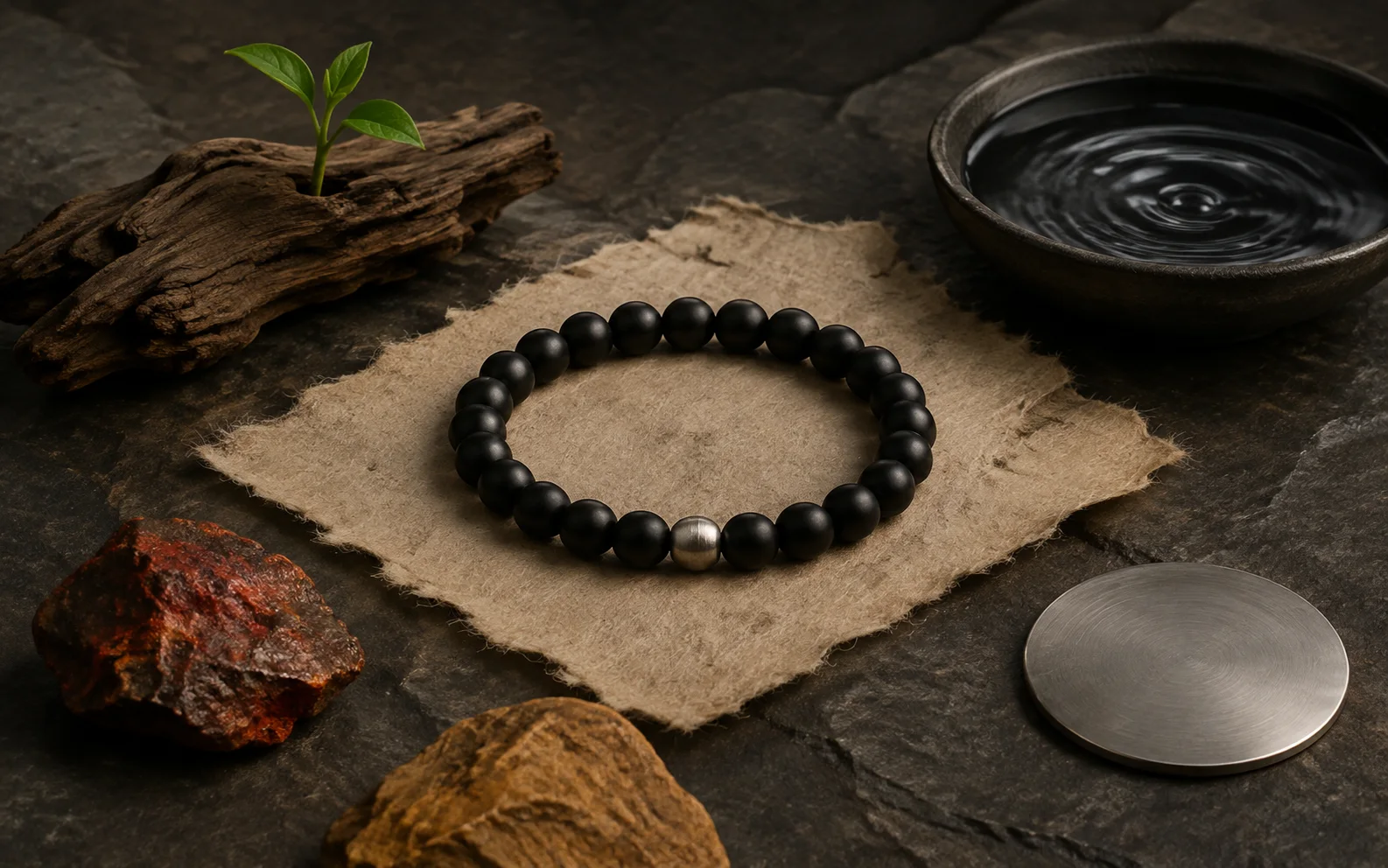
The World Is Always Becoming
In Chinese philosophy, the Five Elements—Wood, Fire, Earth, Metal, and Water—are often better understood as the Five Phases or Five Transformations.
Unlike the classical Western idea of elements as fixed building blocks, wuxing describes dynamic, interdependent modes of change. The system became influential across Chinese philosophy, cosmology, aesthetics, medicine, government, and everyday culture.
A seed rises. A flame expands. The earth receives. Metal refines. Water returns to stillness.
Each phase becomes the beginning of another.
Wood: The Energy of Becoming
Wood represents growth, direction, curiosity, and renewal.
It is the force of the branch reaching toward light and the root searching through darkness. In personal reflection, Wood may symbolize a new beginning, an idea taking form, or the courage to move beyond a familiar boundary.
When Wood feels balanced, there is vision without restlessness.
Fire: The Energy of Expression
Fire illuminates, warms, reveals, and transforms.
It is associated with passion, visibility, joy, and the willingness to be fully present. Fire can symbolize creative expression, attraction, celebration, and the moment an inner idea becomes visible to the world.
Too little Fire can feel like hesitation. Too much can become exhaustion.
Earth: The Energy of Centering
Earth receives, nourishes, and holds.
It symbolizes steadiness, belonging, care, and the quiet strength of remaining present. Earth is not simply stillness—it is the center through which change becomes sustainable.
Earth reminds us that growth requires somewhere to return.
Metal: The Energy of Refinement
Metal represents clarity, structure, discernment, and release.
Like ore shaped through pressure and heat, Metal is associated with choosing what matters and letting go of what no longer belongs. It can symbolize boundaries, precision, integrity, and the beauty of simplicity.
Metal asks: what remains when the unnecessary falls away?
Water: The Energy of Return
Water flows downward, adapts to form, and gathers in hidden places.
It symbolizes intuition, depth, rest, memory, and the unseen beginning beneath every visible beginning. Water does not force its path, yet it changes stone through patience.
Its lesson is not passivity, but responsive strength.
A Cycle, Not a Label
The Five Elements are sometimes used as personality categories, but their deeper value lies in movement.
You are not only Wood, Fire, Earth, Metal, or Water.
At different moments, you may need:
Wood to begin;
Fire to express;
Earth to stabilize;
Metal to simplify;
Water to listen.
The question is not, “Which element am I forever?”
Which movement is asking to enter my life now?
ElementsZen presents the Five Elements as cultural symbolism and a framework for personal reflection, not as a scientific diagnosis or prediction.
A cultural map, not a health reading
Traditional Chinese medicine also links the five phases with zang systems and emotions: Wood–Liver–anger; Fire–Heart–joy; Earth–Spleen–pensiveness; Metal–Lung–grief; Water–Kidney–fear. These historical systems are not simply the anatomical organs of modern medicine.
We share these correspondences to explain the tradition, not to interpret your health. Feeling worried does not identify a deficient element, and a stone is not a treatment. Our ritual uses landscape, gesture and word preferences to suggest an element; your chosen everyday need guides the curated objects and a small personal practice.